Why Won’t My TurfTech T-4600E Start?
A no-crank or slow-crank condition on a TurfTech T-4600E often traces back to the electric start motor system. When you turn the key and hear nothing but a single click, or a labored groan from under the hood, the starting circuit demands immediate investigation. This guide walks you through diagnosing the T-4600E’s starter motor, solenoid, battery, and related wiring using a multimeter and basic hand tools. For a complete swap of the starter assembly, refer to our TurfTech T-4600E Electric Start Motor Replacement: Step-by-Step Guide.
How Do I Test the Battery Voltage First?
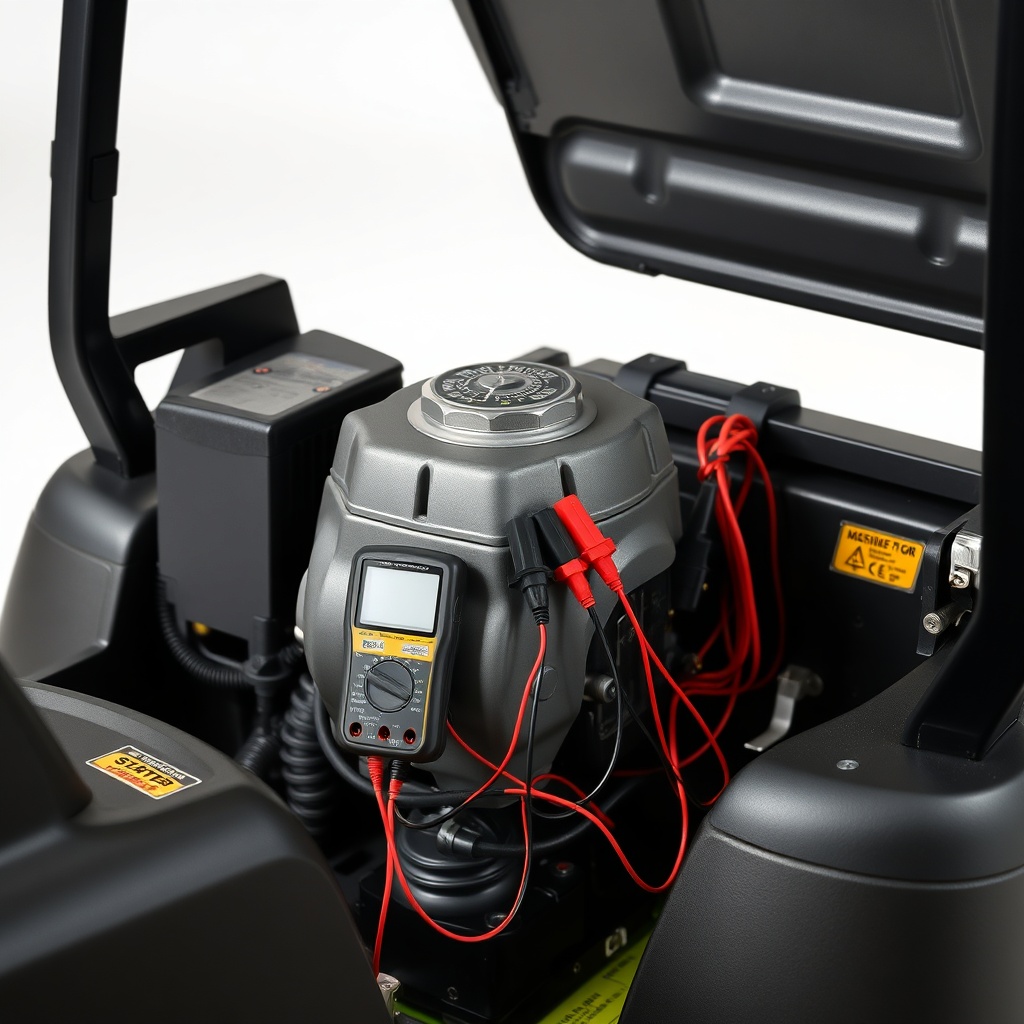
Before blaming the starter motor itself, confirm the battery can deliver enough amperage. A fully charged lead-acid battery should read 12.6 V or higher at rest. With the key in the Start position, voltage should not drop below 10.5 V. If it dips lower than 10 V, the battery likely has a weak cell or insufficient charge. Charge the battery and load-test it at a local shop. If voltage holds above 10.5 V while cranking, the battery is not the root cause. Remember that corroded battery terminals or loose connections can mimic a dead battery. Clean and tighten both positive and negative cables at the battery, the frame ground, and the starter solenoid lug.
What Does a Clicking Sound Mean on a T-4600E?
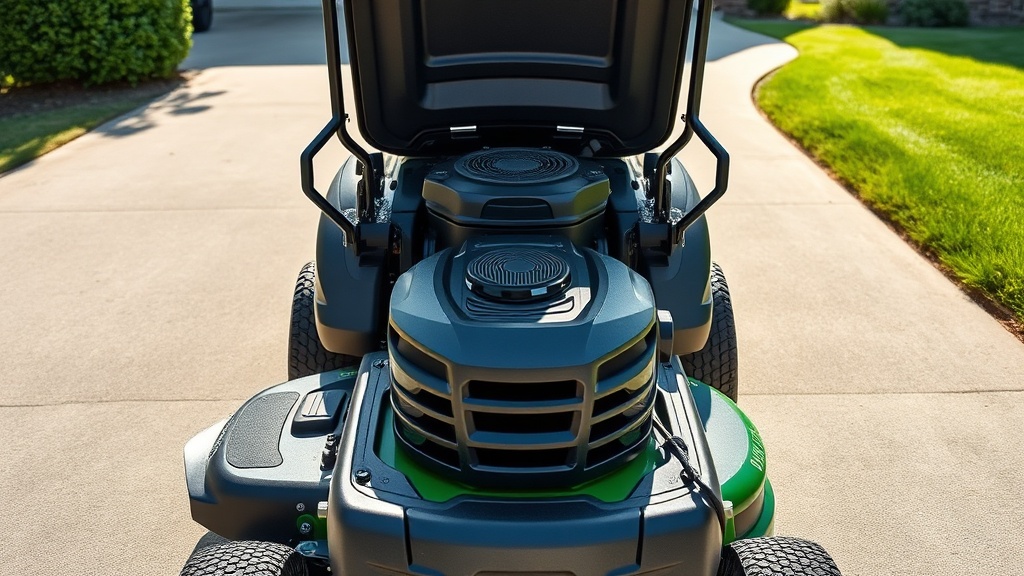
A single, sharp click when turning the key usually indicates the starter solenoid is engaging but the starter motor is not turning. This can stem from three conditions: a seized starter motor, a high-resistance connection at the starter, or a failed solenoid contacts inside the solenoid assembly. If you hear rapid clicking (like a machine-gun rattle), the battery voltage is likely too low to hold the solenoid closed. In the T-4600E, the solenoid is mounted near the starter under the blower housing. If you suspect the solenoid is bad, see our TurfTech T-4600E Starter Solenoid Replacement: Step-by-Step Guide. For a more permanent click-only sound, proceed to test the starter motor directly.
| Symptom | Likely Cause | Severity | Estimated Repair Cost (EUR) |
|---|---|---|---|
| No sound, no click | Dead battery, ignition switch, blown fuse | Low | 0 – 30 |
| Single click, no crank | Seized starter motor, bad solenoid, high resistance | Medium | 50 – 150 |
| Rapid clicking | Weak battery, poor ground, undersized cables | Low | 0 – 50 |
| Slow crank, labored | Worn starter bushings, low battery, oil viscosity | Medium | 80 – 200 |
| Starter spins, engine does not | Failed Bendix drive, missing teeth on flywheel | High | 150 – 400 |
How Do I Bench Test the TurfTech T-4600E Starter Motor?
To isolate the starter motor from the rest of the starting circuit, you can bench test it. First, disconnect the negative battery cable, then remove the starter motor from the engine.
- Visual inspection: Check for oil leaks around the nose cone, cracked housing, or signs of overheating (discoloration).
- Ohm the field coil: Set your multimeter to ohms (Ω). Measure between the positive terminal (usually a 10mm stud) and the starter housing. You should see a low resistance reading between 0.1 and 0.5 Ω. An open circuit (infinite resistance) indicates a failed winding.
- Spindown test: Connect a fully charged battery to the starter using jumper cables: positive to the starter terminal, negative to the housing. The pinion gear should kick out and the armature should spin freely at high RPM. If it fails to spin, the brush pack or armature is defective.
- Bendix drive check: Manually push the drive gear toward the nose. It should move smoothly and spring back. Stuck or worn teeth require a replacement drive, not the whole motor in many cases.
If the motor fails bench testing, you will need a new starter assembly. For installation steps, read our TurfTech T-4600E Electric Start Motor Replacement: Step-by-Step Guide. If the motor bench tests fine but still does not crank on the mower, the problem lies in the wiring or solenoid.
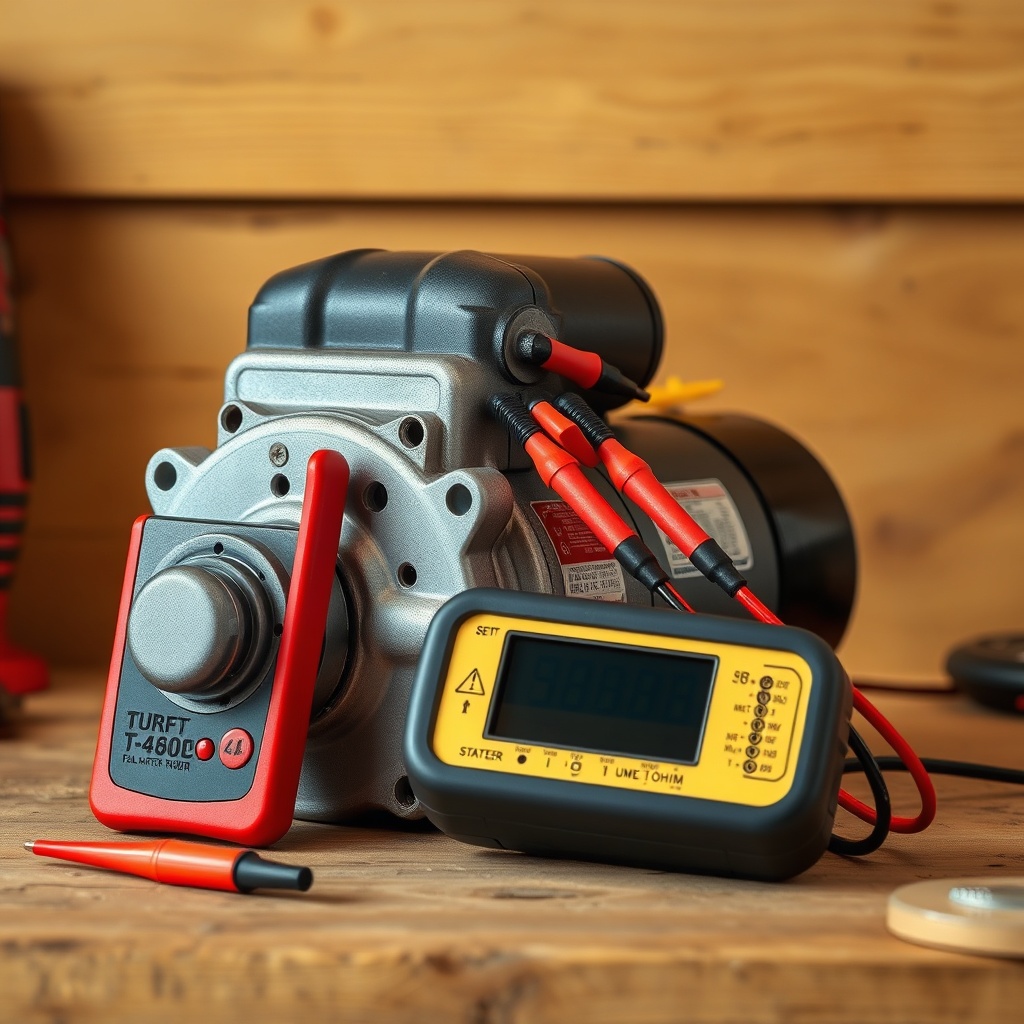
How Do I Diagnose the Starter Solenoid and Wiring?
The starter solenoid on the T-4600E serves as a high-current relay. It typically has three terminals: two large (battery input and starter output) and one small (trigger from the ignition switch). Use this process:
- Set your multimeter to DC volts.
- Probe the large terminal that connects to the battery positive. It should read battery voltage (12.6 V or higher).
- Have an assistant turn the key to Start. Measure voltage on the small trigger terminal. It should rise to 12 V. If not, the ignition switch, safety switches (seat, brake, PTO), or wiring loom is faulty.
- While still in Start, measure between the two large terminals. If the solenoid clicks but you see no voltage on the output terminal, the solenoid internal contacts are burned.
- If the solenoid clicks but the starter output voltage is the same as input voltage, the solenoid is fine—move to the starter motor cable from solenoid to starter. Check for corrosion at the starter terminal.
Warning: The solenoid on the T-4600E is not serviceable—replace the entire solenoid if contacts are bad. See our TurfTech T-4600E Starter Solenoid Replacement: Step-by-Step Guide for procedure.
What Owners Say About T-4600E Starting Problems
Experienced TurfTech owners on forums and repair groups consistently report three recurring themes when diagnosing the T-4600E’s electric start:
- Ground corrosion: Many users found that cleaning the engine-to-frame ground strap resolved intermittent no-crank conditions. The strap, located near the starter motor mount bolt, collects grass and moisture over time.
- Bendix jamming: Several owners noted that a hardened grease buildup on the Bendix drive shaft prevents the pinion from engaging the flywheel. A simple cleaning with brake cleaner and a lightweight grease (white lithium) restored function without replacing the starter.
- Solenoid failures at ~300–400 hours: The T-4600E solenoid tends to fail after extended use, often due to arcing across the contacts. Multiple owners recommend proactively replacing the solenoid at the first sign of clicking alongside a battery voltage check.
Another common tip: always check the deck engagement before cranking. A stuck PTO switch can send voltage to the safety interlock, preventing the starter from engaging. Also, inspect the TurfTech T-4600E Modular Pin System Deck Adjustment: Step-by-Step Guide to ensure the deck is not locked in a raised position that could interfere with safety circuits.
Frequently Asked Questions
1. What type of starter motor does the TurfTech T-4600E use?
It uses a permanent-magnet gear-reduction starter motor with a pre-engaged Bendix drive. The motor is rated for 1.4 kW and features a separate solenoid mounted on the motor housing.
2. What is the correct battery specification for the T-4600E?
Factory recommends a Group U1-7 battery with 340 cold cranking amps (CCA) at 0°F. A larger battery with 500 CCA is also acceptable if space permits, but ensure terminal orientation matches.
3. Why does my T-4600E starter spin but the engine does not turn over?
This indicates a failed one-way clutch (Bendix drive) that is not engaging with the flywheel ring gear. Replace the Bendix drive assembly or the entire starter motor. This is not a solenoid issue.
4. Can I lubricate the starter motor on a TurfTech T-4600E?
Only the Bendix drive shaft should be lightly lubricated with white lithium grease. Do not oil the motor stator or commutator. Sealed bearings do not require maintenance.
5. How do I check if the starter relay is bad?
On the T-4600E, there is no separate starter relay—the solenoid also acts as the relay. Use the voltage drop test described above. If the solenoid clicks but the motor does not turn, test the cable from the solenoid output to the starter. Resistance should be under 0.1 Ω per meter.
6. Should I replace the starter motor just for a slow crank?
Not immediately. First, measure battery voltage under load, clean all connections, check engine oil viscosity (use SAE 10W-30 in cold weather), and inspect the ground strap. If all pass, then test the starter with a bench test. Slow cranking can also be caused by a failing alternator not charging the battery fully—check charging voltage at 13.5–14.5 V running.
For additional lawn equipment issues like noise, leaks, or belt problems, see our TurfTech T-4600E Muffler Upgrade: Noise Reduction and Performance Improvement, TurfTech T-4600E Engine Oil Leak: Diagnosis and Repair Guide, and TurfTech T-4600E Deck Belt Tension Adjustment: Step-by-Step Guide.